 ultimate-guide
The Real History Behind Saint Nicholas
Table of Contents
- The Real History Behind Saint Nicholas: What We Actually Know
- Was Saint Nicholas a Real Person?
- The Saint Nicholas Origin Story: Patara, Myra, and the World He Lived In
- Bishop of Myra: Faith, Persecution, and Generosity
- Saint Nicholas and Santa Claus: How a Fourth-Century Bishop Became Father Christmas
- The Saint Nicholas Feast Day and Traditions Around the World
- Relics, Veneration, and the Spread of Devotion Across Europe
- Conclusion: Bringing the Real History Home
- Frequently Asked Questions
Last Updated: October 9, 2026
The Real History Behind Saint Nicholas: What We Actually Know
The real history behind Saint Nicholas begins in the fourth century, in the port towns of Asia Minor, and it is far stranger and more grounded than the stocking-and-chimney version most families know. Nicholas of Myra was a Christian bishop who lived through the Roman Empire's last great persecution, gave away his inherited wealth, and was remembered for it for seventeen centuries.
Here's the honest catch: almost nothing about Nicholas was written down while he was alive. Below, we'll show you exactly what historians can verify, what they can't, and how a bishop from Myra became Santa Claus.
Was Saint Nicholas a Real Person?
Yes. Most historians accept that a bishop named Nicholas served the church in Myra, in the region of Lycia, during the fourth century. He is not a medieval invention or a folk character who got promoted to sainthood.
The evidence is circumstantial but consistent. Early Christian writers and church calendars place him in Myra. According to the Encyclopaedia Britannica entry on Saint Nicholas, Nicholas is traditionally said to have died around 343 AD in Myra.
What makes him unusual is how thin the primary record is. We have no contemporary biography, no letters, no writings of his own. Everything we "know" about his deeds comes from sources written well after his death.
What Historians Can Verify vs. What Comes from Legend
The verifiable core is small: a bishop named Nicholas, based in Myra, in Lycia, in the fourth century, who was venerated soon after his death.
Almost everything else falls into a different category. The stories of secret nighttime gifts, the saving of three condemned men, the destruction of a pagan temple: these come from hagiography, the genre of writing about saints' lives that flourished in the centuries after Nicholas died. Hagiography was never intended as journalism. It was written to inspire devotion and to present the saint as a model of Christian virtue.
This doesn't make the legends worthless. It makes them evidence of what Christians valued, and of why Nicholas's memory survived when so many other bishops' did not.
The Saint Nicholas Origin Story: Patara, Myra, and the World He Lived In
The Saint Nicholas origin story starts in Patara, a coastal city in Lycia, on what is now Turkey's Mediterranean coast.
Lycia in the fourth century was a prosperous, well-connected province of the Roman Empire. Myra, its principal city, sat near major shipping routes, which meant its bishop mattered beyond the local congregation.
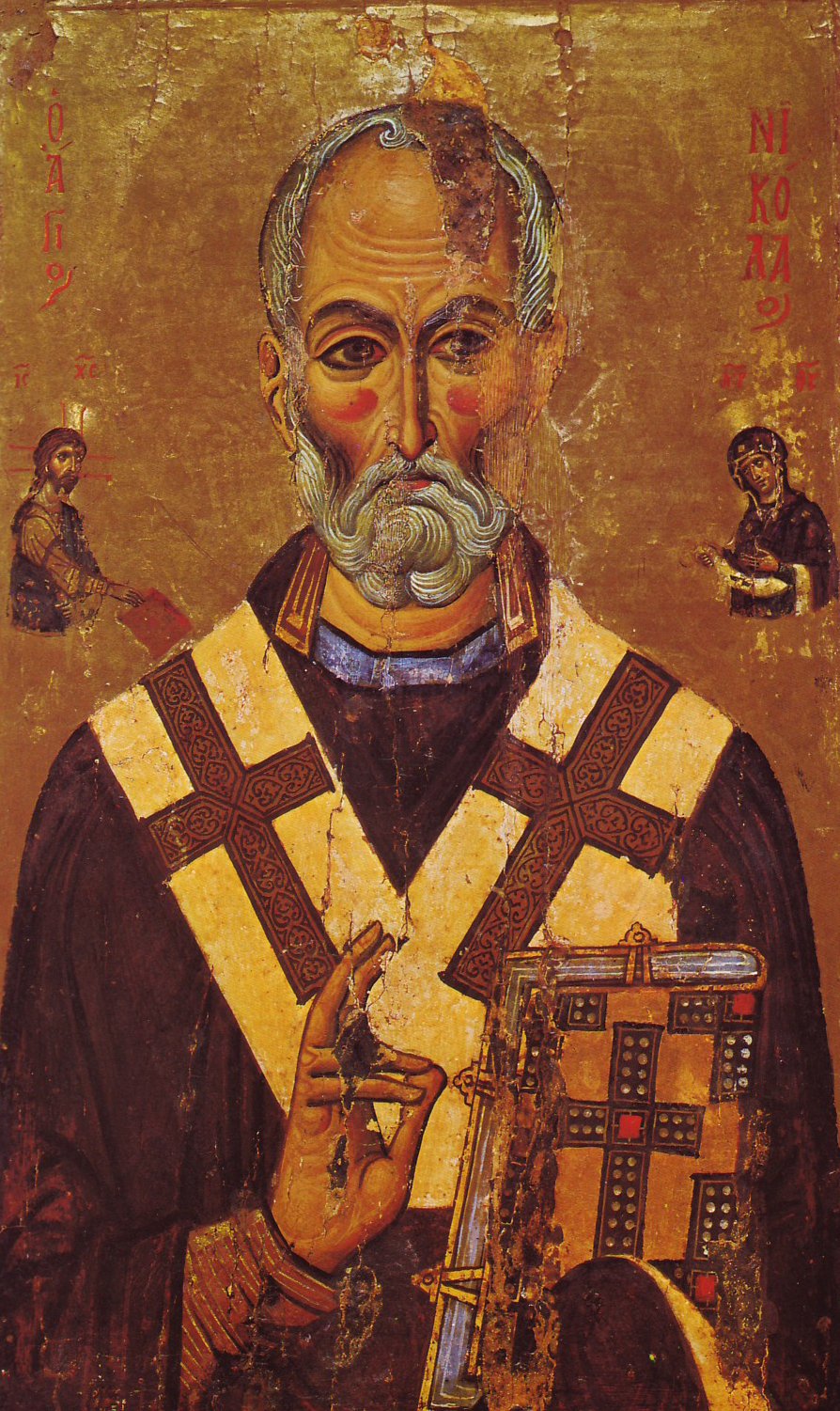
ST. NICHOLAS OF MYRA — 13TH CENTURY. Artist Unknown. Saint Catherine’s Monastery, Mount Sinai. Wikimedia Commons. Public Domain
Nicholas's parents are said to have died when he was young, leaving him a substantial inheritance. What he did with that money became the defining thread of his story.
A Dated Timeline of Nicholas's Life and the Growth of His Cult
The dates below mix documented history with traditional dating. We've flagged which is which, because the distinction matters.
Period | Event | Historical Status |
|---|---|---|
c. 270-280 AD | Born in Patara, Lycia | Traditional |
c. 300 AD | Becomes bishop of Myra | Traditional |
303-311 AD | Great Persecution under Diocletian | Documented |
c. 325 AD | Council of Nicaea (attendance disputed) | Disputed |
c. 343 AD | Death in Myra | Traditional |
4th-6th c. | Earliest written accounts of his deeds | Documented |
1087 AD | Relics transferred to Bari, Italy | Documented |
That last row is the turning point. The transfer of Nicholas's relics from Myra to Bari in southern Italy reshaped his legacy entirely, spreading devotion across Western Europe at a speed the Eastern church had never seen.
Bishop of Myra: Faith, Persecution, and Generosity
Persecution is not a footnote in Nicholas's story. It's the setting. The Great Persecution, launched under the emperor Diocletian in 303 AD, was the most severe official campaign against Christians in Roman history, and it hit the eastern provinces hard.
According to the Metropolitan Museum of Art's essay on the Roman Empire's persecution of Christians, the campaign targeted clergy specifically, ordering church leaders arrested and forced to sacrifice to the Roman gods. Bishops were prime targets.
Tradition holds that Nicholas was imprisoned during this period and released when the persecution ended. The details are unverifiable, but the era is not in question. A bishop in Myra in the 300s would almost certainly have faced pressure, and many did far worse.
His reputation, though, rested on money. Specifically, on giving it away quietly.
The Three Poor Sisters and the Gift of Dowries
The best-known story attached to Nicholas concerns three sisters whose father could not afford dowries for them. In that society, a dowry was the difference between marriage and destitution, and a father without one faced desperate choices for his daughters.
According to the tradition, Nicholas threw bags of gold through the family's window at night, on three separate occasions, one for each daughter. He did it in secret, and the father reportedly discovered the source only on the third night.
Whether or not it happened exactly that way, this story is the seed of everything that followed: the secret gift, the nighttime delivery, the focus on the vulnerable. It is also, historians generally agree, the origin of the Christmas stocking tradition.
Saint Nicholas and Santa Claus: How a Fourth-Century Bishop Became Father Christmas
The Saint Nicholas and Santa Claus connection is not a straight line from Myra to the North Pole.
The first leg is the Dutch Sinterklaas. In the Low Countries, Nicholas's feast on December 6 was a children's holiday with small gifts, sweets, and a bishop figure in robes and mitre.
The second leg is the literary makeover.
The third leg is the visual one. From the 1860s onward, Thomas Nast's Harper's Weekly illustrations gave the figure a workshop, a list of good and bad children, and a red suit.
What survived the transformation was not the bishop's office but his function: a figure who gives to those who need it, quietly, without asking for credit. That is the thread that runs from the three poor sisters in Myra to the modern chimney story, and it is the part worth keeping.
If you want to walk your family through that relay race, the Dutch boat, the American poem, the illustrator's pen, our free games, trivia, and downloadable coloring pages at christopherkringle.com are built to make the history click for kids.
The Saint Nicholas Feast Day and Traditions Around the World
In the Western Catholic and Protestant regions of northern Europe, December 6 became a children's day.
In the Eastern Orthodox churches, Nicholas is venerated as a wonderworker (in Greek, Thaumaturgos) and his feast days carry serious liturgical weight.
In Italy, especially Bari, the city that holds his relics celebrates with processions, civic ceremonies, and a feast that is as much about local identity as about the saint.
If you are introducing Saint Nicholas to children, the December 6 feast is a natural entry point: it is distinct from Christmas, it has concrete customs (shoes, sweets, small gifts), and it lets you tell the bishop's story before the Santa story takes over. Our free printable coloring pages and downloadable music at christopherkringle.com are designed for exactly that kind of family introduction. Everything is free for parents.
One figure, a dozen different holidays. That flexibility is exactly why the traditions survived, and why the real history behind Saint Nicholas is still being retold in different languages, in different churches, on the same December day.
Relics, Veneration, and the Spread of Devotion Across Europe
The transfer of Nicholas's relics to Bari in 1087 turned a regional saint into a European one. Sailors from Bari removed the remains from Myra, and the relics became the foundation of a major pilgrimage site.
From Bari, devotion spread through trade routes, monasteries, and port cities. Nicholas became the patron saint of sailors, merchants, and children, a combination that made sense for a coastal bishop whose most famous act involved saving three girls from poverty.
According to the Basilica di San Nicola in Bari's official history of the relics, the tomb in Bari has drawn pilgrims continuously for nearly a thousand years. That's the real engine behind the legend: not a single story, but centuries of people deciding this bishop was worth remembering.
Conclusion: Bringing the Real History Home
The challenge with Nicholas is that the true story and the beloved story don't match neatly, and most families end up with only the second one. We think kids can handle both, and that the fourth-century version, a bishop who gave away his inheritance in secret and lived through persecution, is the more inspiring of the two.
That's why our nine-book saga, our free games and trivia, our downloadable music and coloring pages, and our call-with-Santa and email-Santa features all start from the history rather than the cartoon. Everything is free for parents at christopherkringle.com. Get started with Christopher Kringle and give your family the real story behind the beard.
Frequently Asked Questions
Was Saint Nicholas a real person?
Yes, most historians agree that a bishop named Nicholas lived in the fourth century in Myra, in what is now Turkey. He is mentioned in early Christian records, and churches were dedicated to him within a few centuries of his death. What is harder to confirm are the many miracle stories that grew up around his name. The historical core is solid; the legendary details are where caution is needed.
What is the Saint Nicholas origin story?
Nicholas was born in Patara, a port town in Lycia, Asia Minor, to a wealthy Christian family. He became bishop of Myra and was known for giving away his inheritance to help the poor. The most famous story tells of three sisters whose father could not afford dowries; Nicholas secretly threw bags of gold through their window at night, saving them from a life of hardship.
How did Saint Nicholas become associated with Christmas?
His feast day on December 6, close to Christmas, made him a natural part of the season. In the Netherlands, Sinterklaas brought gifts on December 5. Dutch settlers carried that tradition to New York, where it blended with British Father Christmas customs. Over time, the gift-giving bishop merged with the modern Santa Claus figure we know today.
What is the difference between Saint Nicholas and Santa Claus?
Saint Nicholas was a real fourth-century bishop in Myra, known for secret gift-giving and care for the poor. Santa Claus is a later cultural figure shaped by Dutch Sinterklaas traditions, nineteenth-century poems, and twentieth-century advertising. Santa lives at the North Pole and delivers toys on Christmas Eve; Nicholas lived in Asia Minor and gave to the needy. One is history, the other is folklore built on that history.
What stories about Saint Nicholas are supported by historical evidence?
The strongest evidence supports his existence as bishop of Myra, his participation in early Christian councils, and his reputation for generosity. The story of the three sisters and the dowries has early roots and is widely accepted as reflecting his charitable work. Miracles attributed to him, such as calming storms or raising the dead, come from later hagiography and are not treated as historical by modern scholars.
How can families explore the real history behind Saint Nicholas together?
Start with the verified facts: his birthplace in Patara, his role as bishop, and his feast day on December 6. Then read the legends as stories that reveal what people valued. For a family-friendly way in, visit christopherkringle.com for free games, trivia, downloadable music, printable coloring pages, and even a chance to call or email Santa. Everything there is free for parents.